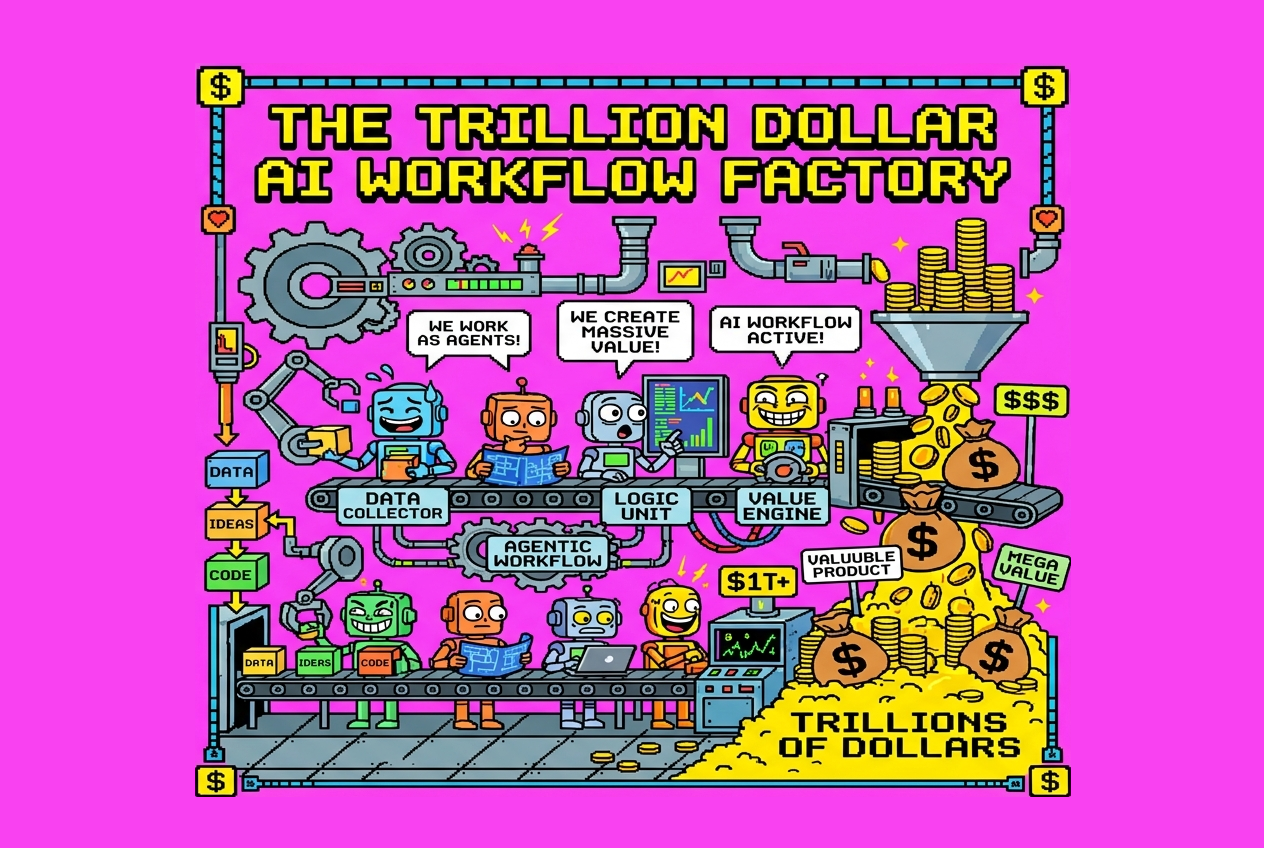
The Trillion Dollar Agentic Workflow
 Adam Neon
The Trillion-Dollar Shift Nobody’s Talking About (And Why It Changes Everything About How You Build With AI)
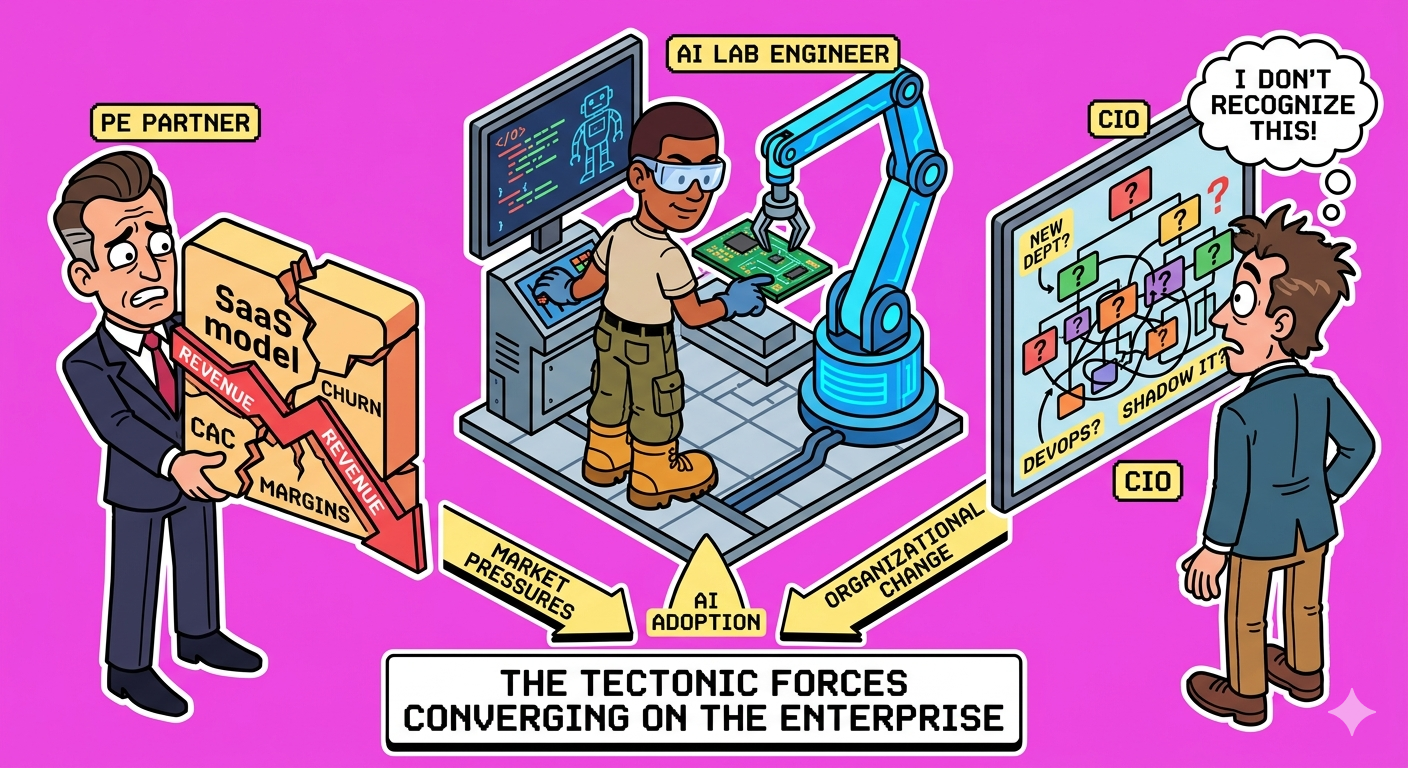
Imagine you’re a private equity partner. It’s 2024. You’ve just closed a fund loaded with SaaS companies. The model is beautiful. SaaS companies were great! They all taste like chicken 🤣 — same growth curves, same balance sheets, same exit math. You buy them, you grow them, you sell them. The spreadsheet sings.
Fast forward to today. Those same SaaS companies are on the rocks. Their customers are asking questions they can’t answer. “Why am I paying per seat when an agent can do the work of ten seats?” The growth metrics that made the spreadsheet sing now read like a eulogy. And your fund — dated 2026, 2027, 2028 — needs an exit strategy that doesn’t exist yet.
Now imagine you’re OpenAI. You’ve raised more capital than God. But you’re still capital-constrained because training models and buying GPUs and serving inference at planetary scale costs money that makes your Series G look like pocket change. And you’ve just realised something that Palantir figured out years ago: you can’t sell AI from a fancy conference room in Silicon Valley. You need forward-deployed engineers sitting in the weeds with customers. You need an implementation army.
Now imagine you’re a Fortune 500 CIO. Six months ago you didn’t know the difference between a chatbot and an agent. Now you’ve seen agents close an entire workflow — end to end, reliably, at scale — and you know two things with absolute certainty. One, this changes everything about how your company operates. Two, you have no idea how to build it yourself.
These three characters are not separate stories. They’re the same story. And they’re all converging on a single point of pressure that’s about to reshape the entire AI economy.
The Squeeze Is Already Here
Something shifted in the last few months. It’s subtle enough that most people missed it, but big enough that the people writing cheques — real cheques, billion-dollar cheques — are reorganising their entire thesis around it.
Here’s what happened. Agents got good enough to do entire workflows. Not assist with workflows. Not summarise workflows. Complete them. End to end. Reliably. At scale. This is a spring 2026 phenomenon. It didn’t exist before. And it changes the math on everything.
Because when an agent can complete a workflow, the value isn’t in the tool anymore. It’s in the completion. And getting to 100% on a workflow — actually closing the loop, actually delivering the outcome — that’s where the disproportionate value lives. That’s where the trillions are.
Four forces are now converging on exactly this point. Understanding them isn’t optional if you’re building or buying AI this year.
Force 1: The Labs Are Moving Down
Anthropic just announced a deployment company with Blackstone, Hellman & Friedman, and Goldman Sachs. $1.5 billion in capital behind it. OpenAI is going after the same thing with a venture valued near $10 billion.
These aren’t product launches. These are deployment armies.
The labs have realised something uncomfortable: shipping the model isn’t enough. You can build the most capable AI in the world and it still won’t deliver value in a real company unless someone sits down and wires it into the actual workflows, the actual systems, the actual mess of permissions and data and edge cases that define how enterprise software actually works.
So they’re hiring engineers. Forward-deployed engineers who embed inside companies. They’re not selling a product anymore. They’re selling an outcome. And the outcome requires bodies on the ground.
This puts pressure on everyone. When Claude releases a design tool, Figma feels it. When OpenAI releases agent templates for finance, every fintech startup feels it. The labs are telling you where they think value lives by where they’re willing to put capital. Pay attention to what they’re hiring for. It’s a cheat sheet.
Force 2: The Consultancies Are Moving Up
McKinsey, BCG, Accenture, Capgemini, PwC. Every single one is inside OpenAI’s Frontier Alliance program. Every single one is building dedicated agentic practices. They’re training delivery teams on production deployment patterns. They’re showing up with engineers who can wire AI into operating systems.
These firms have decades of relationships with the exact decision-makers who are now desperate to deploy agents. They sit in the same rooms as the CIOs and CFOs who control the budgets. They don’t need to cold-call. They pick up the phone.
If you’re a startup selling AI agents — and let’s be honest, that’s what everyone with an API key is doing right now — you’re not just competing with other startups. You’re competing with McKinsey’s existing relationship with the C-suite. Good luck with that cold outreach sequence.
Force 3: The Systems of Record Are Closing Ranks
Salesforce. ServiceNow. Workday. SAP. Every single one has opened APIs and agent frameworks. They want agents to call their platform directly — with their permission, their audit trail, their governance.
They don’t need a startup sitting between their data and a customer’s agent. In fact, they’d prefer you didn’t exist. And every quarter, they make it easier for an agent to work inside their ecosystem without a middleware layer.
SAP just bought Dreamio and Prior Labs for exactly this reason — a governed data play that says “stay inside our walls, we’ve got this.” Disrupting a system of record is harder than it’s ever been. They’ve learned from the last wave of SaaS disruption. They’re not making the same mistake twice.
Force 4: Private Equity Has Become a Distribution Channel
This is the one most people miss, and it’s the most important.
A PE firm owns thousands of mid-market companies. Finance. Operations. Support. Procurement. Compliance. And every single one of those companies is desperate to get more efficiency out of their operations through AI.
Here’s what makes PE different as a distribution channel: they can introduce one deployment partner across their entire portfolio. Standardise the playbooks where the same patterns repeat. Compare results across companies. Do it once and sell it fifty times.
That’s not vendor-by-vendor sales. That’s a completely different distribution shape. And if you’re not thinking about it, you’re not in the game that actually matters.
This is why OpenAI and Anthropic can raise billions for deployment companies. PE has the capital. PE has the portfolio. PE needs the AI story to sell their companies. And the labs need the capital and the distribution. The incentives align perfectly.
What This Means for You
Here’s where it gets practical. If you’re shipping a generic AI wrapper — something that sits on top of a model, accesses some data, and calls itself an agent — you are going to get squeezed by all four of these forces simultaneously.
The labs will build whatever you’re building as a feature. The consultancies will sell against you with relationships you can’t replicate. The systems of record will make your middleware unnecessary. And PE will back the deployment companies that can scale across entire portfolios while you’re still doing one-to-one enterprise sales.
The defensibility window for generic AI wrappers is closing. It might already be closed.
So where does the value actually live?
The Implementation Layer
Everyone’s fighting over where the leverage point is. The labs say it’s the model. Salesforce says it’s the data. The memory companies say it’s the memory.
They’re all partially right and mostly wrong.
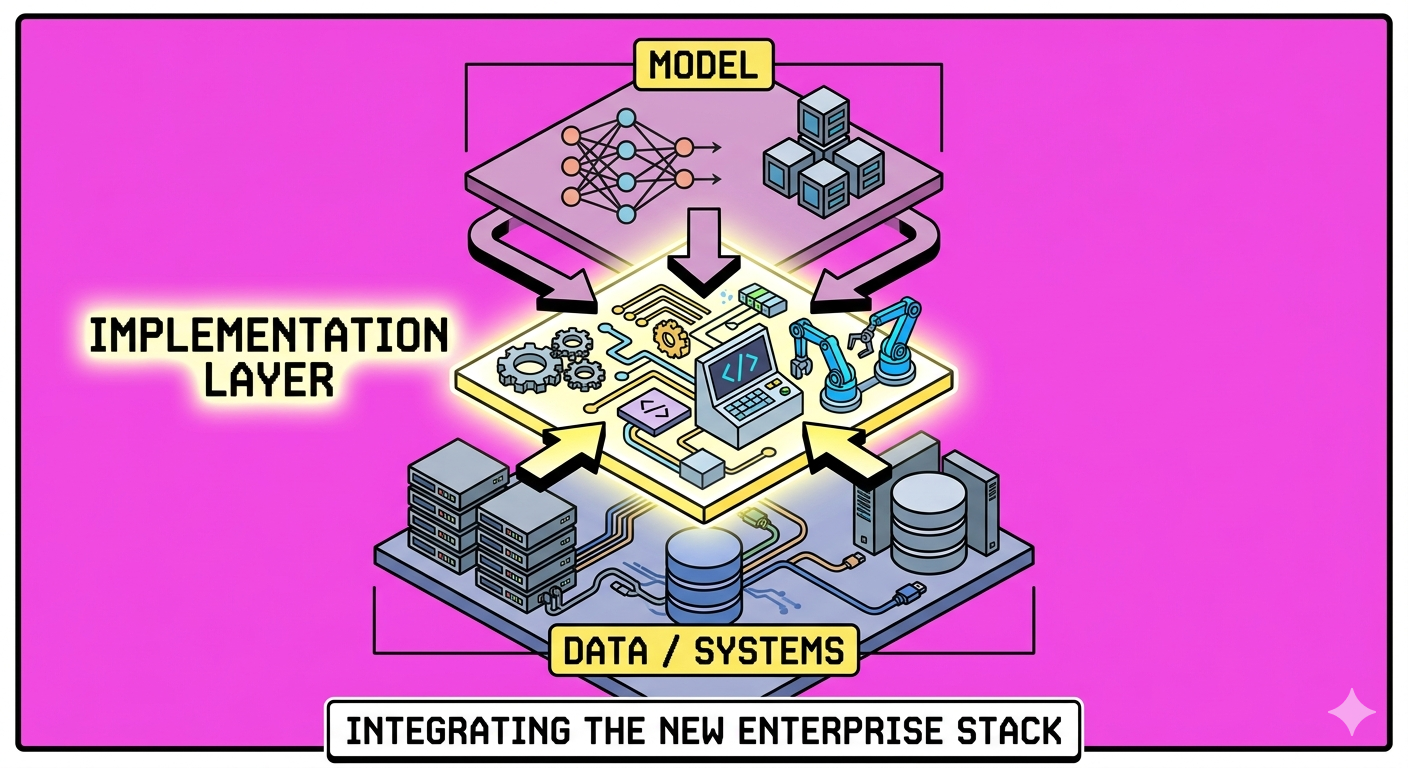
The real leverage is in the implementation layer — the specific set of components that turn a capable model into an actual business outcome. And most companies haven’t built any of them.
Here’s what’s actually in an implementation layer:
Workflow design. Which decisions does the model get to make? What steps stay human? Where are the handoffs? What counts as done? This isn’t a prompt. It’s a defined process where every step has an owner, an input, and an output. Most teams ship a model attached to a tool without a workflow definition behind it. That’s why their agents don’t work.
Data access. Which sources of truth does the agent read? Which permissions apply at the row and field level? Which records are authoritative and which are stale? The model can produce a very confident answer from a six-month-old PDF or from a live record. You probably care which.
Authority. What is the agent allowed to do? Against which systems? With what spending limits? Reading is one risk profile. Writing is a completely different one. Spending is something you can’t undo.
Evals. How do you measure whether the agent’s output is correct, complete, and safe before it goes anywhere? Evals aren’t a benchmark. They’re the way you score the model’s adherence to specific business rules. If you can’t tell me what’s in your eval, you can’t tell me whether your agent works.
Audit trails. What gets logged? What can an auditor reconstruct after a failure?
Recovery. What happens when the agent does something wrong? How does an action get reversed? Who keeps the system tuned and up to date?
None of these are model work. All of them have extraordinary impact on the total package of value. And every vendor will tell you they’re selling you that value. Unless they’re coming in to actually build it for you, they’re not.
The value lies with the builders. The value lies with the people who can assemble a model, a harness, and data into an actionable workflow that is custom to a specific company’s reality.
Sit Closer to the Business Object
If I were building in the next twelve months — whether you’re in the enterprise or selling to it — here’s the principle that matters most.
Generic intelligence becomes valuable when it gets attached to the specific objects and actions that define real work. Not abstract reasoning. Not better summarisation. The actual business objects that drive workflows.
A support agent doesn’t need to be smarter. It needs to understand cases, policies, customers, entitlements, and escalation paths — and act against them to close tickets. A sales agent doesn’t need better prompts. It needs to understand the entire funnel as a set of objects it can move through systematically.
This requires thinking about your data layer and your implementation layer as one integrated substrate. Not a model bolted onto a database. A unified system where the agent understands the shape of the work.
The vendors who win in the next six to twelve months won’t be the ones with the best model. They’ll be the ones who can answer hard questions about how their implementation layer actually works at a discrete level. Ask them what’s in their evals. Ask them about their authority model. Ask them about recovery.
If the answer is “the model is getting better every week” or “we trust your data” — walk away. They’re selling you last year’s product at this year’s prices.
The Bigger Picture
We’re living through an implementation layer war. Not a model war. Not a data war. An implementation war. And the reason is simple: people have figured out there are trillions of dollars in getting this right. Everyone is converging on the same point of value — the completed workflow — and nobody has clearly claimed ownership yet.
It is not a foregone conclusion that Claude will own all these workflows. It’s not a foregone conclusion OpenAI will. It’s not a foregone conclusion anyone will. That’s why everyone’s staking a claim. That’s why the deployment companies exist. That’s why the PE firms are writing billion-dollar cheques.
And for anyone building in this space — whether you’re inside a company wiring agents into operations, or outside it selling the wiring — the opportunity is genuinely wide open. The disproportionate value isn’t in generic software that “tastes like chicken.” It’s in custom implementation. It’s in sitting close enough to the business object that you understand the work better than anyone else.
That’s not something a model release can commoditise overnight. That’s not something Claude Code can build over a weekend. That’s the real work. And the people who do it are going to capture the value.
The Question
Most businesses are still buying AI the way they bought SaaS in 2018. Per-seat pricing. Generic promises. Vendor slide decks full of benchmarks that have nothing to do with their actual operations.
The companies that win the next decade won’t be the ones with the biggest AI budget. They’ll be the ones who built the implementation layer that actually delivers outcomes. They’ll be the ones who sat close enough to their own business objects to understand what “done” really means.
So here’s the question: if you looked at your own company’s AI efforts right now — the agents you’ve deployed or the ones you’re planning to deploy — how many of the implementation layer components I just described have you actually built?
Workflow design. Data access. Authority. Evals. Audit trails. Recovery.
Be honest with yourself. Because the trillion dollars isn’t going to the people with the best prompts. It’s going to the people who built the system that actually works.
Would you do the work to build yours?