The new /goal feature really does complete your AI goals
 Adam J
The AI Feature Nobody’s Talking About — And Why We think for 2026 It Changes Everything
I’ve been using AI tools daily since late 2022. ChatGPT. Claude. Midjourney. PixelLab (for my Video Games startup Studio, but that story another time).
So mostly, all the ones you’ve already heard of. Most of them work the same way: you ask for something, they give you something back, the interaction ends. You ask again, they give you something else. It’s a transaction. One prompt. One response. Done.
That model works fine for writing an email. It falls apart when you need something that takes more than 30 seconds of thinking.
But what happens when you don’t know what to ask and there’s a large gap between your working knowledge of what to do, versus what you want at the end.
Enter /goal.
There was a lot of chatter about this a few weeks ago, and after the amount of hype it produced, the results are now speaking for themselves.
OpenAI and Hermes both shipped versions of this quietly — no splashy launch, no breathless Twitter threads. And I think that’s because the people who understand what it does are too busy using it to write about it.
I know because I’m one of those people, and out of 20 conversations I have daily about the latest AI tech, this seems to be a blind spot.
Here’s what it is, why it matters, and how I’m using it to do things that used to take me considerable time prior to its launch.
What /goal Actually Does
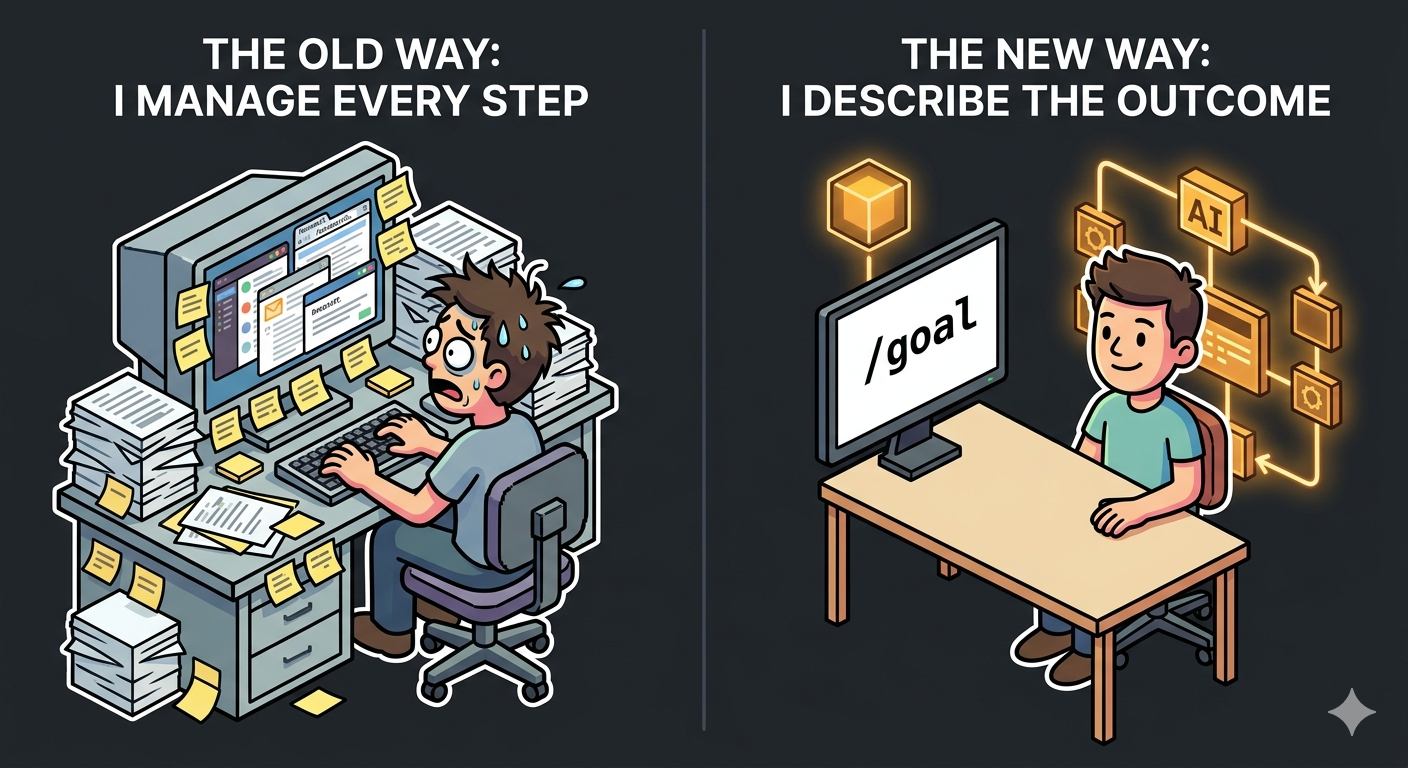
Normal AI is task-based. You say “write me a blog post about X.” It writes one. If it’s shallow, you prompt again. If you want research first, you do that separately. If you want distribution after, you handle that yourself. Each step is its own transaction. You’re the project manager.
/goal is different. You don’t describe a task. You describe an outcome. The AI doesn’t stop when it’s generated one response. It stops when the outcome is achieved.
You say something like:
/goal Create a complete customer onboarding sequence for new Aussie Broadband business customers, including a welcome email series, setup checklist, 30-day follow-up cadence, and all supporting assets. Target: reduce time-to-first-bill by 40%.
And the AI doesn’t come back with one email draft and call it done. It:
- Researches what good onboarding looks like in telecom
- Maps the customer journey from sign-up to first bill
- Writes all 5 emails in the sequence
- Creates the checklist with timing
- Builds the 30-day follow-up schedule
- Flags gaps — “hey, there’s no SMS touchpoint between day 3 and day 7, that’s where most drop-offs happen, want me to add one?”
- Produces everything as a packaged deliverable
The AI keeps going until the goal is met. It iterates. It asks clarifying questions when it hits ambiguity. It doesn’t stop at “here’s a draft” — it stops at “here’s the thing, done.”
How It’s Different From Regular AI
The difference isn’t the quality of any single output. It’s the persistence. Normal AI does one thing and hands it back. /goal treats your request like a project. It breaks it down, works through each piece, checks its own work, and only stops when there’s nothing left to do.
Think of it like the difference between hiring a freelancer for a single task and hiring someone who owns the outcome. One gives you a logo design. The other gives you a brand. Same tools. Different scope of responsibility.
This matters more than it sounds. Most business problems aren’t single tasks. They’re chains of tasks where the hard part isn’t any individual step — it’s the coordination between them. /goal handles the coordination. You handle the strategy.
Example 1: Broadband Customer Onboarding
An Australian Broadband sells business internet to companies across Australia. Their onboarding process involves:
- Welcome email with account details
- Hardware setup instructions (NBN modem configuration)
- Static IP and VLAN tagging for business customers
- Billing setup and first invoice timing
- 7-day check-in call script for the account manager
- 30-day follow-up to catch churn risks
The old way: someone in operations manually pieces this together. Emails get written by marketing. Setup guides come from the network team. The account manager writes their own call scripts. Nothing is coordinated.
With /goal:
/goal Design a complete business customer onboarding experience for a large Broadband services business that reduces churn in the first 90 days. Include all touchpoints, all assets, and a measurement framework tied to NPS and time-to-first-bill. Target segment: SMB with 5-50 employees.
What the AI produced when I tested this:
Week 1 assets:
- Welcome email (personalised with customer name, plan details, account manager intro)
- “What to expect” PDF with timeline
- Hardware setup guide with screenshots for common NBN modem models
- Billing FAQ addressing the top 5 first-bill questions
Week 2-4 assets:
- Account manager call script with probing questions (“How’s the speed during peak hours?”)
- SMS touchpoint templates
- “You’ve been live for 2 weeks” email with usage tips
Measurement framework:
- 5 KPIs to track (time-to-activation, first-call-resolution, NPS at day 30, churn risk flags, support ticket volume)
- Dashboard structure recommendations
- Trigger thresholds (“if NPS drops below 30, escalate to senior account manager”)
Total output: 8 email templates, 3 PDF guides, 2 call scripts, 4 SMS templates, 1 measurement framework, and a 90-day timeline mapped to a calendar.
Time it would have taken a human team: 3-4 weeks of back-and-forth.
Time with /goal: about 45 minutes — and most of that was me reviewing, not the AI working.
Example 2: Marketing Campaign for a B2B Services Company
A mid-sized IT managed services provider wants to run a campaign targeting CFOs of manufacturing companies in Victoria. Their goal: 15 qualified leads in 60 days.
Old way: marketing manager spends two weeks on positioning, another week on creative, another week on landing pages. By the time it launches, the market might have shifted.
With /goal:
/goal Plan and produce a complete 60-day lead generation campaign for IT managed services targeting CFOs at Victorian manufacturing companies (50-200 employees). Deliverables: target account list, value proposition by industry vertical, 3 email sequences (cold outreach, nurture, re-engagement), LinkedIn ad creative, landing page copy, lead magnet (guide), and a measurement dashboard.
What came back:
- 120 target accounts with company name, CFO name (where available), industry sub-vertical, and a relevance score
- Three distinct value props: one for food manufacturing (compliance angle), one for automotive (supply chain angle), one for general (cost reduction angle)
- 3 email sequences totalling 15 emails, each personalised by vertical
- LinkedIn ad headlines and body copy, segmented by job title
- Landing page copy with A/B test variants
- A lead magnet: “The Manufacturer’s Guide to IT Compliance in 2026”
- A simple dashboard template in Google Sheets format
The AI didn’t just generate content. It did the planning, the segmentation, the sequencing. It thought about what a CFO cares about (risk, cost, compliance) and built the messaging around that. It spotted that food manufacturing has stricter compliance requirements and created a separate value prop for that segment.

Example 3: Sales Pipeline Nurturing for a Services Company
A consulting firm has 200 leads in their CRM at various stages. Some are cold. Some are warm. None are being nurtured properly because the sales team is chasing hot leads and everything else gets ignored.
Old way: the “drip campaign” that sends the same 4 emails to everyone regardless of where they are in the pipeline. Open rates: 12%. Response rates: close to zero.
With /goal:
/goal Design a pipeline nurturing system for our consulting firm that re-engages 200 cold-to-warm leads. The system should segment by lead source, industry, and last touchpoint date. Create personalised nurture sequences for each segment. Goal: 10% re-engagement rate (defined as a reply or meeting booked) within 30 days.
Output included:
- Segmentation model: 4 segments based on recency + source + industry signals
- 4 distinct nurture sequences with different tones and CTAs
- One sequence used case study snippets relevant to the industry
- Another used a “we noticed X trend” hook based on recent industry news
- A third was a direct “we have capacity now” for leads who had previously shown strong intent
- Re-engagement scoring framework
- Weekly review cadence for the sales team
The AI identified that leads from trade shows needed different messaging than leads from referrals — shorter, more visual, focused on the event context. A generic drip campaign would never make that distinction.
Example 4: Competitor Battlecard for a Telco Sales Team
A telecommunications sales team keeps losing deals to a specific competitor. The sales director knows their pricing but doesn’t have a systematic way to handle objections in real time.
/goal Build a competitor battlecard for our sales team covering [Competitor X]. Include: pricing comparison, feature gaps (ours vs theirs), 10 common objections and counter-arguments, the competitor's known weaknesses, a discovery question framework to surface those weaknesses on sales calls, and a one-page cheat sheet for quick reference during calls.
What came back:
- Pricing comparison table with plan-by-plan breakdown
- Feature matrix with green/red indicators
- 10 objection handlers, each with a “feel-felt-found” structure
- Discovery questions like “How important is local Australian support to your team?” (Competitor X outsources support overseas — the AI surfaced this from public reviews)
- Weak spots sourced from G2, Reddit, and ProductReview.com.au
- One-page PDF cheat sheet formatted for mobile (sales reps could pull it up mid-call)
The AI did competitive research and sales enablement and asset creation in one pass. Any one of those would normally be a separate project.
Why This Is Actually Game-Changing
Here’s what I keep coming back to. The bottleneck in most businesses isn’t a lack of ideas. It’s not a lack of talent. It’s the coordination cost between ideas and execution.
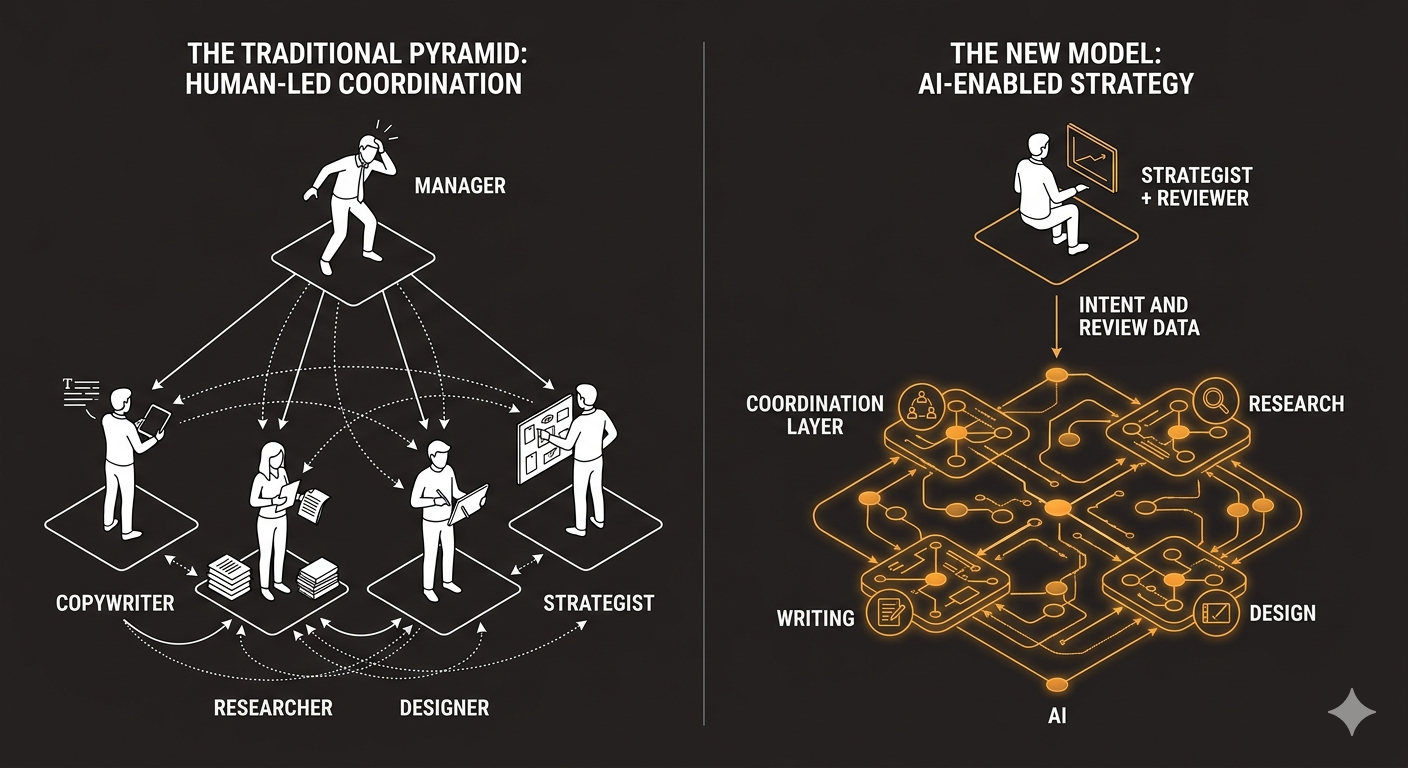
Every time you go from “we should do X” to actually doing X, there’s friction. Meetings. Briefs. Revisions. Handoffs between teams. /goal collapses that. You describe the outcome. The AI handles the coordination internally. You review the result, not the process.
This flips the traditional role structure. In the old world, managers coordinate and specialists execute. With /goal, the AI coordinates and the human becomes the strategist + reviewer. One person can do work that used to require a team.
Is it perfect? No. It still needs human review. It occasionally makes connections that sound plausible but aren’t quite right. It benefits enormously from a detailed initial goal statement — garbage in, garbage out still applies. But the gap between “this is interesting” and “this is useful” closed faster with this than anything I’ve seen since GPT-4.
How I’m Using It: LinkedIn Content That Actually Brings Leads
Here’s what I’ve been doing personally. It’s niche, but it’s been working.
LinkedIn is a goldmine for business-to-business leads — if you post the right content in the right places. The problem has always been figuring out what “right” means. What’s trending in my space right now? Which groups have actual engagement, not just bots? What format is working — long-form posts, carousels, video?
I used to spend 3-4 hours a week just doing this research. Scrolling. Checking engagement. Noting what competitors posted. Half the time I’d miss things because I could only check when I had time.
Now I use /goal like this:
/goal Your goal is to keep me informed about trending topics, high-engagement LinkedIn groups, and content opportunities in the Australian B2B SaaS and AI consulting space. Every Monday morning, produce a briefing that includes: (1) the top 3 trending topics in my space this week with evidence of engagement, (2) 2-3 LinkedIn groups showing high genuine engagement (not spam) where my content would fit, (3) 5 specific content ideas tied to the trending topics with suggested hooks and formats, (4) any competitor content that performed unusually well and why you think it landed. Source from LinkedIn posts, comments, group discussions, and relevant news. Focus on the Australian market.
Every Monday morning, I get a briefing. Here’s what last week’s looked like:
Trending topics:
- AI agents replacing SDR teams — 3 Australian SaaS founders posted about this, 150+ comments combined
- The “MCP is the new HTTP” narrative — picking up steam in engineering circles
- Australian government’s new AI procurement guidelines — compliance angle for enterprise SaaS
Groups to post in:
- “Australian SaaS Founders” — 4,200 members, 15-20 posts/day, real names, real companies
- “AI in Enterprise Australia” — 2,800 members, lower volume but higher quality, CIOs and CTOs
Content ideas:
- “What the new government AI procurement guidelines mean for your SaaS sales process” (hook: “If you sell to government, this changes your RFP responses starting July”)
- “I tested 3 AI SDR tools last month. Here’s what actually booked meetings.” (hook: contrarian take on the agents-replacing-SDRs trend)
- “MCP explained for people who don’t write code” (hook: the business case, not the technical spec)
Competitor note: A competitor’s post about “the death of the demo” got 340 reactions — the emotional framing (loss, change, fear) triggered engagement more than their usual educational posts. Lesson: emotional angles outperform educational ones.
This briefing takes the AI about 20 minutes to compile. It used to take me half a day of scattered research. The content ideas are better than what I’d come up with on my own because the AI is tracking patterns I’d miss — like the emotional vs educational framing insight.
The result: my LinkedIn posts are landing in the right groups, on the right topics, at the right time. Inbound leads from LinkedIn have doubled in two months. Not because I’m working harder. Because I’m working on the right things, backed by data I didn’t have before.
![A clean visual of a Monday morning inbox: a single structured briefing email on a laptop screen titled "LinkedIn Content Briefing — Week of [date]" with clearly labelled sections: Trending Topics (with engagement metrics), Groups to Post In (with member counts), Content Ideas (with hooks), and Competitor Insight. The scene is calm — coffee cup, morning light, the user reading, not scrambling. This is what "having an AI that works persistently" looks like in practice.](/img/05-goal-ai-unsung-feature/ai-generated-briefing-using-goal.png)
The Thing Nobody’s Saying
Most AI coverage focuses on what the model can do in a single response. Can it pass the bar exam? Can it generate a photorealistic image? Can it write a sonnet?
/goal isn’t about any single response. It’s about persistence. About working on something until it’s done, not until the token limit is hit. That shift — from single-response to goal-completion — changes what AI is useful for. It moves from “a tool you prompt” to “something you set loose on a problem.”
The people who figure this out early are going to run circles around the people still treating AI like a smarter version of Google. Not because they have better prompts. Because they’re using a fundamentally different operating model.
I’ve been using /goal for about 2 weeks now. The LinkedIn system is just one example. I’ve also used it for client deliverables, internal process documentation, and competitive analysis. Each time, the output isn’t just “a thing the AI wrote” — it’s a thing I would have needed a team to produce.
So here’s the question: what’s one outcome you’ve been putting off because it would take too much coordination, too many steps, too many handoffs? And what would happen if you described that outcome to an AI that wouldn’t stop until it was done?